


How LiteracyPlanet Works

Adaptive Learning for Every Student

Students build literacy in different ways, whether they are learning in class, at home or across both. Some are ready for richer texts but need spelling support. Others are strengthening the phonics foundations that make reading feel more achievable.

Literacy Planet’s adaptive platform gives each learner a clear pathway from Prep to Year 10, with curriculum-aligned activities that adapt as they progress. Students build confidence step by step, while teachers and parents can see where they are improving and where they may need extra support.

How Students Learn with LiteracyPlanet

Step 1: Students Start with a Placement Check

When a student first logs in, LiteracyPlanet assesses their current level across key literacy strands. This feels like a game, not a test. The platform identifies what the student already knows and where gaps exist.

This creates a personalised starting point that matches their actual ability, not just their year level. For example, a Year 8 student might need support with Year 6 grammar while working at a Year 10 level in comprehension. 

Step 2: The Platform Assigns Level-Appropriate Activities

Based on the placement results, students are guided to activities matched to their level and learning needs. 

Every activity is curriculum-aligned to the Australian Curriculum, UK National Curriculum, Common Core, and 70+ other frameworks. What students learn through gamified learning directly supports what they cover in class.

The platform covers all major literacy strands in depth:

  • Phonics — letter sounds, blending, and word recognition for early primary students and older learners who need foundational support
  • Spelling — patterns, rules, and high-frequency words from simple CVC words to complex morphology
  • Reading Comprehension — literal, inferential, and evaluative skills through age-appropriate texts across multiple genres, from picture books to complex passages
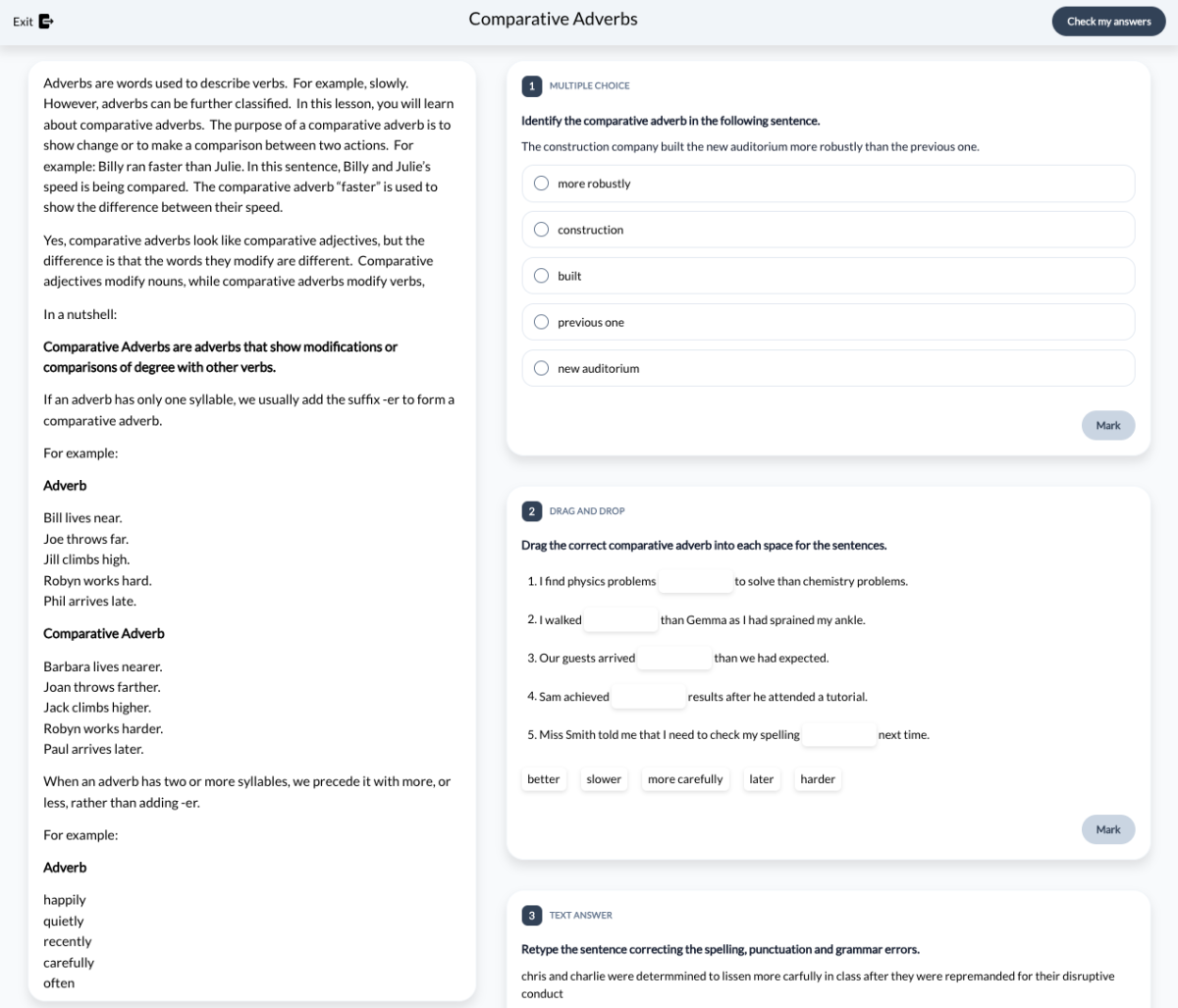
  • Grammar — sentence structure, punctuation, and parts of speech, taught across subject disciplines, from basic capitals to advanced clause construction
  • Vocabulary — word meanings, context clues, and academic language, including targeted instruction in subject-specific vocabulary, for primary and secondary students.

Step 3: Students Progress Through Engaging Activities

Learning on LiteracyPlanet feels like playing, not studying. Students explore Storyverse, an immersive world where every literacy task is woven into a narrative.

As they complete activities, students earn rewards, unlock new levels and build their characters. Younger learners enjoy animated games and visual progress, while older students take on challenges that feel age-appropriate. 

LiteracyPlanet tracks what they understand and where they may need more practice. Teachers and parents can see this progress, while the platform uses the same insights to guide each student’s next step. 

Step 4: The Platform Adapts in Real Time

When a student struggles with a concept, LiteracyPlanet adjusts the difficulty and provides extra practice. When they show mastery, the platform moves them forward.

This happens automatically, helping each student work at the right level without teachers needing to assign different tasks for every learner manually.

What LiteracyPlanet Covers

LiteracyPlanet supports students from their first year of school through to secondary English, with curriculum-aligned learning across Australia, the UK and the United States. 

With 10,000+ activities structured along the Literacy Continuum, students build skills in a clear, sequential way. Each activity is grounded in evidence-based learning science and independently certified by Digital Promise.

For primary learners, this means strong support across phonics, spelling, vocabulary and foundational writing. For secondary students, personalised learning helps address gaps while extending grammar and vocabulary skills, with real-time reporting to guide teachers and families.

How You Can Use LiteracyPlanet

LiteracyPlanet is built to fit the way students learn in real life, across classrooms, homework and home learning. Through personalised learning, it provides each learner with activities matched to their level, while teachers and families can see progress clearly and support the next step. 

For Teachers and Schools

Teachers get a real-time view of every student’s progress, including who is on track, who needs support and which skills need attention. Activities can be assigned manually or automatically matched to each student’s needs.

Reports are easy to generate, with no spreadsheets or manual tracking. Schools can use LiteracyPlanet for classroom learning, homework programs or targeted intervention, with cohort-level insights for leaders and practical support for teachers. 

For Parents and Home Learning 

Parents see a different view of the same platform. can see what their child has learned, where they are progressing and when they may need extra support. The dashboard is easy to understand, making it simple to follow and celebrate learning at home.

For home learning or homeschooling, students receive curriculum-aligned activities matched to their level. Families can manage multiple children in one subscription, with 24/7 access across devices.

Why LiteracyPlanet Works

LiteracyPlanet is trusted by 500+ schools and 125,000+ students across 40+ countries. As a multiple GESS Education Awards finalist and winner, it has been recognised globally for innovation and impact in literacy learning.

As part of 3P Learning, LiteracyPlanet is backed by a proven leader in educational technology, with the stability and experience to support schools at scale.

Schools and families continue using LiteracyPlanet because students make real progress. Teachers see reading levels improve, parents notice children choosing to learn independently, and school leaders can track measurable gains in cohort literacy data within a term.

See It in Action

Ready to see how LiteracyPlanet could support your learners? View our available plans to explore the platform and see how students can build literacy skills at the right level, whether they are learning at school, at home or across both.


Skip to toolbar